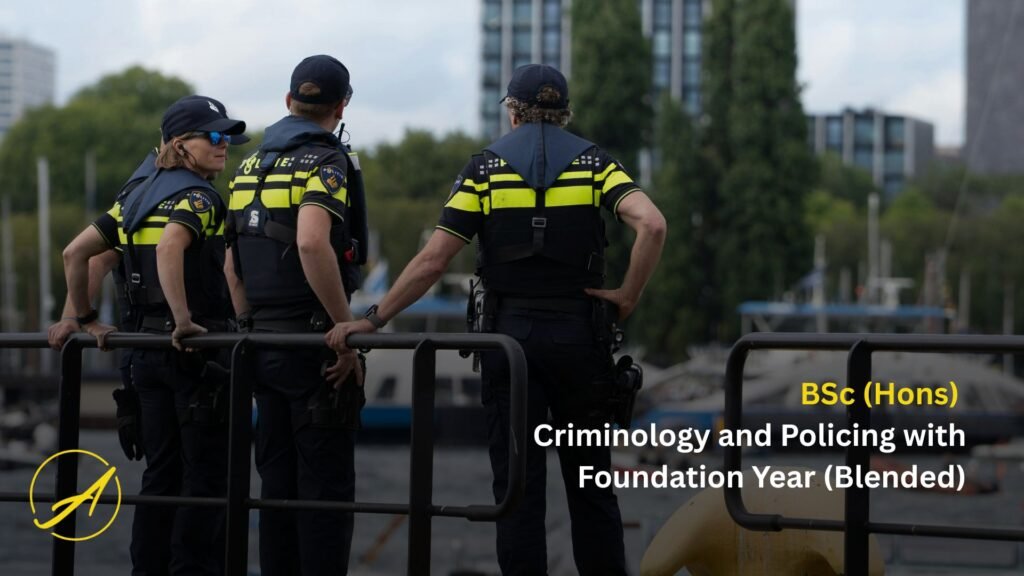
BSc (Hons) Criminology and Policing with Foundation Year (Blended)

Master the mechanics of law enforcement, criminal behavior, and the modern justice system with the BSc (Hons) in Criminology and Policing. This dynamic undergraduate program is strategically engineered to equip ambitious professionals with forensic analytical expertise, contemporary policing frameworks, and criminological literacy, preparing you for high-impact law enforcement, criminal justice, and public protection roles across the global security and rehabilitation sectors.
BSc (Hons) Criminology and Policing with Foundation Year (Blended)

Intake:

January, June, September

Location:

London, Birmingham, Manchester, Leeds

Duration:

4 years

Fees:

£9,250 per year
The BSc (Hons) Criminology and Policing delivers a comprehensive, industry-aligned exploration of social harm, penal systems, and professional police operations. It is ideal for aspiring police officers, probation workers, and crime analysts looking to enhance their operational literacy, specialize in major crime investigation, and rapidly secure a highly sought-after qualification that bridges the gap between theoretical sociology and frontline law enforcement.

Throughout this degree, you will study police powers, cybercrime, and the psychology of offending. Shifting away from rigid, passive examinations, the curriculum champions an authentic, practice-based learning layout. You will be challenged to execute live policy briefings, manage simulated police interviews, and evaluate real-world forensic evidence using innovative teaching approaches—including virtual reality (VR) and metaverse technologies to recreate active policing scenarios.

A defining strength of the program is its emphasis on contemporary security shifts, specifically focusing on terrorism, major crime operations, and the socio-economic factors driving systemic inequality. You will work on rapid evidence reviews, public protection blueprints, and active crisis management strategies, ensuring you graduate with the precise analytical confidence demanded by modern police forces and government agencies.

Graduates of this program are exceptionally well-prepared for prestigious, high-demand careers as Police Constables, Probation Officers, Crime Analysts, and Youth Justice Workers. Delivering an industry-validated academic benchmark, this bachelor’s degree provides a definitive foundation for students considering the police degree-holder entry route, while also preparing you to seamlessly advance into specialized Master’s-level criminal justice study.

Optional Foundation Year (Level 3 – Year 0)

  • Communication Skills – Developing professional communication styles appropriate for formal criminal justice environments.

  • Digital and Research Skills – Navigating digital research platforms and ethical data parsing.

  • Core Concepts of Criminology & Law – Establishing the fundamental theories of the legal system and criminal behavior.

  • Foundation Year Project – Developing independent research skills through a formative portfolio and written project.

Year 1 (Level 4)

  • Core Concepts of Criminology – Analyzing the historical development and evolution of criminological thought.

  • The Police Constable Role – Exploring the foundational duties, ethics, and community expectations of modern policing.

  • Police Powers and Custody – Navigating the statutory legislation governing arrest, search, and suspect rights.

  • Becoming A Researcher 1 – Developing skills in quantitative data processing and descriptive statistics.

Year 2 (Level 5)

  • Criminological Theory – Applying key behavioral theories to historical and current societal issues related to crime and harm.

  • Police Interviewing – Mastering the psychological and legal frameworks of interviewing suspects, witnesses, and victims.

  • Public Protection – Evaluating safeguarding strategies for vulnerable individuals and managing community risk.

  • Research Methods in Practice – Gaining hands-on experience in qualitative analysis and inferential statistics for crime data.

Year 3 (Level 6)

  • Major and Serious Crime – Investigating the complex operational logistics of homicide, organized crime, and counter-terrorism.

  • Cybercrime and the Media – Navigating digital offending and how the media frames crime, creates moral panics, and impacts social control.

  • Prisons and Probation – Evaluating the penal system, rehabilitation models, and the psychology of incarceration.

  • Dissertation / Independent Major Project – Executing an exhaustive independent research project solving a real-world policing or criminological issue.

  • Standard Three-Year Route (Year 1 Entry): Minimum of 112 UCAS tariff points from 3 A-Levels or equivalent (e.g., BBC at A-Level, or a BTEC Extended Diploma at DMM), paired with GCSE passes at grade C/4 or above in English Language.

  • Integrated Four-Year Route (Year 0 Entry): Lower tariff entry requirements apply for the Foundation Year pathway. Non-standard entry is also warmly open to mature applicants (21+) who possess relevant professional or life experience, verified via a comprehensive CV screening and an academic interview.

  • English Proficiency: For non-native speakers, an IELTS Academic score of 6.0 (with no individual component lower than 5.5) or an approved equivalent is strictly required.

Funding Your Studies with Student Finance

You may be eligible to receive financial support from the UK Government to help cover your tuition fees and living expenses while studying.

Tuition Fee Loan – Covers 100% of your tuition fees, paid directly to the university, so you can focus on your studies without financial stress.
Maintenance Loan – Helps with living costs, including rent, food, and travel, making student life more manageable.

At Active Care Education, we simplify the process for you! Our expert team will guide you step-by-step, ensuring you secure the funding you’re entitled to. If you’re a British Citizen, Refugee, have Indefinite Leave to Remain, or hold EU Pre-Settlement Status (2.5 – 3 years), you could qualify for this government-backed funding.

Why wait? Start your journey towards a degree without upfront costs! Contact Active Care Education today for free assistance.

Book Your Free Online Consultation!

    Residency status*
    British citizenEU pre-settlementILRRefugeeOthers

    FAQ

    What does the course cover?

    Expect to study core disciplines including cognitive psychology, the criminal justice system, and criminological theory. You will explore quantitative research methods, forensic psychology, and biological behavior tailored specifically around contemporary social and justice landscapes.

    What are the career prospects?

    Graduates step into highly competitive roles such as Crime Analyst, Probation Officer, Behavioral Researcher, and Intelligence Officer. The broad curriculum supports rapid placement across the police force, government agencies, NGOs, and the clinical support sectors.

    Are there traditional timed exams on this course?

    This program is highly practical and focuses on professional application. Your progress is primarily evaluated through authentic, coursework-based assessments. Marks are earned through simulated policy briefings, rapid evidence reviews, self-reflective diaries, and independent research portfolios. There are generally no traditional written exams.

    Can I become a Chartered Psychologist with this degree?

    This degree is designed to align with core psychological curriculum requirements, but you should check specific accreditation status (such as BPS Graduate Basis for Chartered Membership) based on the intake year and specific module selection if your goal is clinical chartership.

    Click to rate this post!
    [Total: 0 Average: 0]

    OUR PARTNERS

    Showcasing our partnerships with leading universities to help you achieve your academic goals.

    REVIEWS FROM STUDENTS

    Scroll to Top

      Residency status*
      British citizenEU pre-settlementILRRefugeeOthers